In modern software testing, ensuring compliance has become a daily balancing act. The pressure to deliver faster releases clashes with the demand to protect sensitive data.
Production data makes tests realistic but turns every environment into a privacy risk.
Masking breaks logic, subsetting hides edge cases, and most teams haven’t yet realized that modern synthetic data can replicate production behavior without exposure.
Each workaround fixes one problem and creates two more. This guide shows how to escape that cycle so that you can test safely, realistically, and fully compliant.
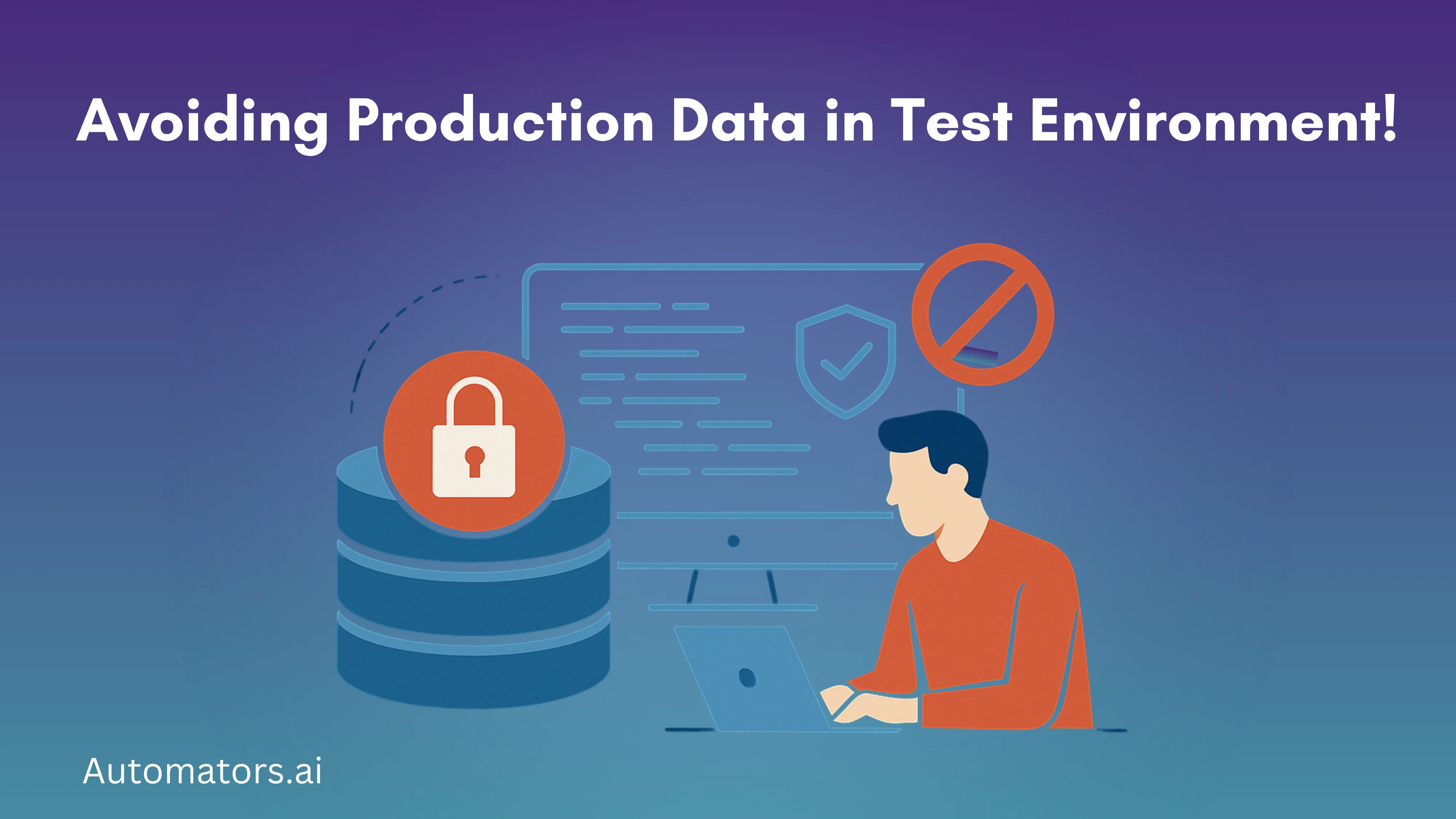
How to Avoid Production Data in Test Environments
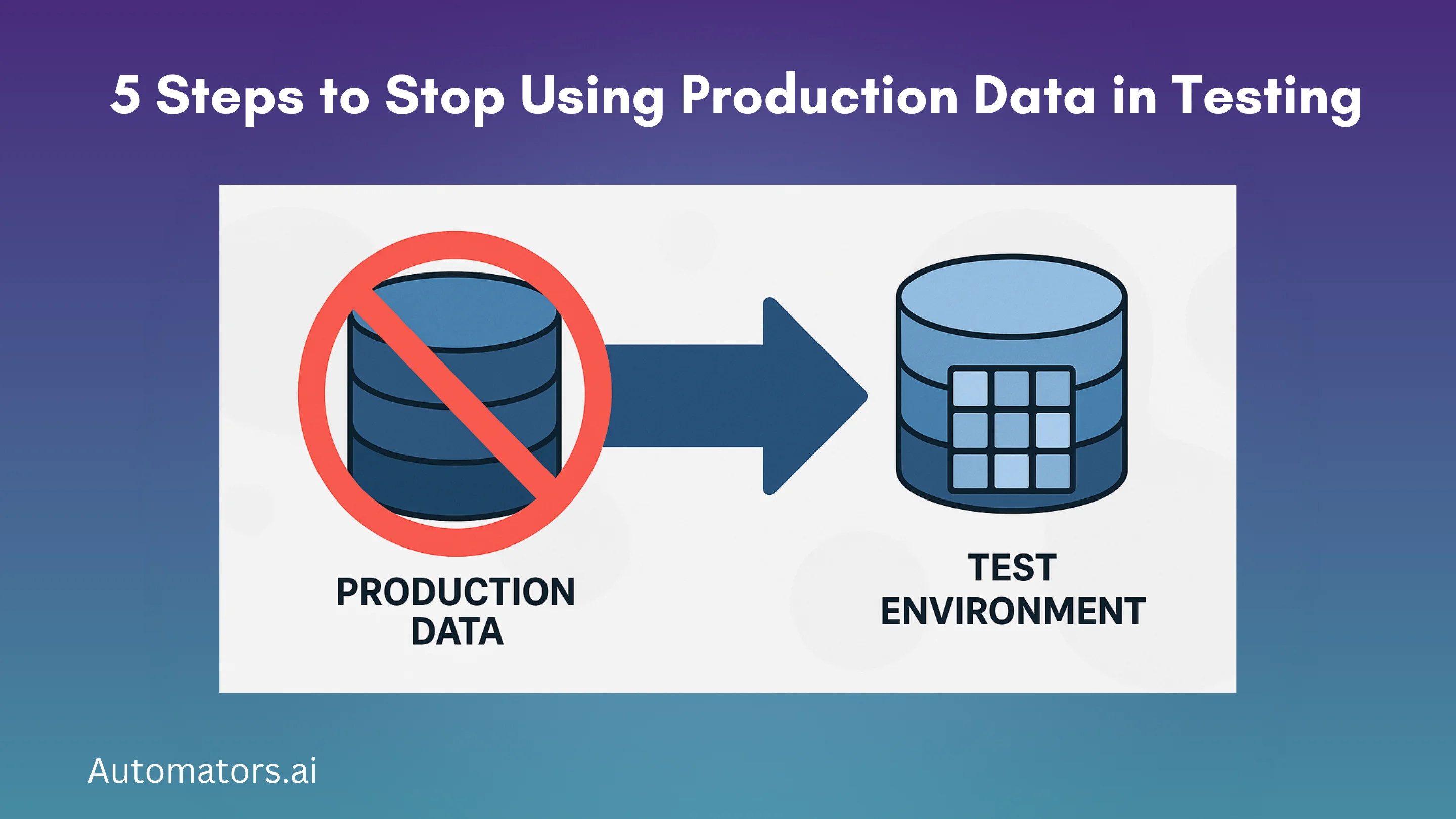
Step 1. Ban Direct Production Data Replication
The first step is cultural and technical: treat production data as radioactive. No test, staging, or development environment should ever contain a copy of production.
Enforce this rule through automation, not trust.
- Block export jobs and dump scripts in CI/CD pipelines.
- Tag and classify production datasets so they can’t be pulled by default.
- Apply Data Loss Prevention (DLP) scans that flag personally identifiable information (PII) in QA imports.
The legal basis is clear. Under GDPR Article 32, organizations must implement “appropriate technical and organizational measures” and regularly test their effectiveness.
In practice, you must prove, not just claim, that non-production environments contain no personal data.
This makes a “no-prod-in-QA” policy not just smart, but mandatory.
Step 2. Replace Production Data with Synthetic Data
If production data is off-limits, QA still needs *something realistic. *That’s where Synthetic Data Generation (SDG) becomes your new foundation.
Synthetic data isn’t anonymized production data. It’s new data, created algorithmically to mirror the structure, statistical relationships, and constraints of real data, without copying any real records.
Modern SDG techniques are powered by Generative AI models:
- Generative Adversarial Networks (GANs): two neural networks compete until the synthetic output is indistinguishable from reality.
- Variational Autoencoders (VAEs): learn latent patterns to recreate statistically coherent samples.
- Large Language Models (LLMs) fine-tuned with Differentially Private Stochastic Gradient Descent (DP-SGD): can generate tabular or transactional data with learned realism while maintaining strict privacy budgets.
Differential Privacy (DP) changes everything. It mathematically guarantees that the presence or absence of any individual’s record in the training data cannot materially affect the generated output.
Even if the synthetic data is analyzed, transformed, or shared, privacy remains intact.
Tools like DataMaker make this practical. Built for enterprise QA teams, it generates compliant, production-like synthetic data on demand, directly inside your existing environments.
With built-in referential integrity, GDPR-ready templates, and REST API support, DataMaker lets you test with realism and speed while ensuring zero exposure of sensitive production data.
Step 3. Use Masking as a Transitional Bridge But Not as a Strategy
Data masking and subsetting once seemed like reasonable compromises. They still have a place, as temporary scaffolding, but not as your long-term strategy.
Masking replaces or scrambles identifiers while preserving data format, but its flaws run deeper than privacy.
Masking not only risks re-identification through quasi-identifiers such as ZIP + birthdate + gender, but it also structurally fails in modern microservices.
The widespread adoption of polyglot persistence, multiple database types within one application stack (SQL for transactions, NoSQL for sessions, document stores for logs), makes consistent masking across systems nearly impossible.
Each datastore applies transformations differently, causing referential-integrity collapse and orphaned or mismatched records.
The outcome is faulty QA results that generate false confidence: tests pass in isolation but fail in production, not because the code is wrong, but because the masked data lost its relational coherence.
Add to this the well-documented re-identification risk. That combination of architectural failure and privacy weakness makes masking an unsustainable long-term solution.
Use it only as a controlled bridge for legacy workflows, and plan your migration to synthetic generation immediately.
Step 4. Automate Test Data Provisioning through DataOps
Even the best synthetic data is useless if developers can’t access it quickly. Manual provisioning slows teams down, breeds shortcuts, and increases risk.
That’s where DataOps, the DevOps of data pipelines, comes in. DataOps unites data engineers, QA, and security through automation, versioning, and continuous validation.
Key actions:
- Automate dataset generation and delivery for every CI/CD test run.
- Validate schema integrity and statistical consistency automatically before deployment.
- Use Dataset SBOMs (Software Bill of Materials) to document lineage: generation method, parameters, validation results, and privacy proof.
The validation stage, often formalized as SynEval, must be dual-focused.
It should quantify both Utility (how faithfully the synthetic data reproduces production-level correlations) and Privacy (how resistant it is to re-identification).
Research shows that nearly 46 % of published synthetic-data studies fail to perform any empirical privacy evaluation, assuming “inherent privacy.”
That blind spot is dangerous in enterprise QA.
Your pipeline should automate re-identification red-teaming and continuously verify that the Differential Privacy ε (epsilon) budget holds under realistic attack simulations.
In other words, make privacy measurable, not just declared.
Behind this, advanced pipelines can include referential-integrity testing, distribution-drift detection, and privacy-budget tracking.
DataOps turns your QA data flow from a static compliance task into a living, auditable process, continuous, measurable, and compliant by design.
Step 5. Build Ephemeral Test Environments Using Infrastructure as Code
Even synthetic data shouldn’t live forever. The safest test environment is one that doesn’t persist.
With Infrastructure as Code (IaC) tools like Terraform or Ansible, you can spin up complete QA environments, containers, databases, APIs, and synthetic datasets in minutes. Once tests finish, everything is destroyed automatically.
This is the Clean-Slate Paradigm:
- No data lingers.
- No configuration drift accumulates.
- No “forgotten staging servers” remain exposed.
Add Zero Trust Architecture (ZTA) on top:
- Micro-segment networks so each test component accesses only what it must.
- Grant ephemeral credentials (valid for one job, then self-expiring).
- Continuously authenticate every request, internal or external.
Compared to traditional masking or encryption, this approach doesn’t merely protect data; it eliminates the data target entirely.
Once you’ve implemented the 5-step playbook, the next challenge is maturity: making your approach scientifically robust, legally defensible, and operationally scalable.
Here are the deeper principles, drawn from data science, regulation, and architecture, that make your pipeline truly future-proof.
Deep Dive: The Foundations Behind the Framework
1. Why Probabilistic Privacy Models Fail
Techniques like k-anonymity or generalization assume attackers have limited external data. That assumption no longer holds.
Modern adversaries use public datasets, social graphs, and AI correlation tools to rebuild identities from “anonymous” records.
Because these methods rely on probabilistic obfuscation, they degrade with time, every new public dataset increases the odds of re-identification.
That’s why regulators and privacy scientists now push toward provable privacy, where guarantees hold under any external context.
Synthetic generation, backed by DP, achieves this by decoupling the dataset’s utility from its original records. The test data behaves like reality, but is not reality.
2. The Regulatory Imperative for Proof
Under GDPR Article 32, privacy controls must be continuously evaluated for effectiveness.
That means companies must demonstrate, via metrics or reports, that their anonymization or generation methods actually work.
HIPAA’s Expert Determination clause goes further, requiring statistical proof that re-identification risk is “very low.”
Financial institutions governed by PSD2 must produce high-fidelity test data to stress-test Strong Customer Authentication and fraud-detection systems.
Regulators are beginning to ask not just whether anonymization is applied, but how its efficacy is demonstrated, turning validation itself into a compliance requirement.
Each of these frameworks points toward the same expectation: Privacy must be demonstrable, not declarative.
In practice, that means running ongoing re-identification tests, publishing privacy-risk scores, and treating synthetic-data pipelines as controlled, measurable assets.
3. Differential Privacy: The Mathematical Firewall
Differential Privacy defines a quantifiable privacy-loss parameter ε (epsilon). A smaller ε means stronger privacy guarantees but more noise.
Balancing ε is both an art and a science.
Your QA pipeline can tune this parameter based on test purpose:
- High-fidelity UI tests → higher ε (more realism).
- Privacy-critical tests → lower ε (stronger protection).
Frameworks like Private Evolution and DP-SGD automate this balancing, enabling enterprise-scale synthesis that satisfies both utility and compliance goals.
DP’s guarantee persists after transformations and merges, privacy at the source, not in process.
4. DataOps + Zero Trust: The Operational Backbone
Combining DataOps and ZTA creates a data-absent architecture, systems where sensitive data never exists outside its source.
- DataOps provides automation, observability, and reproducibility.
- Zero Trust ensures no implicit trust, even between internal components.
- Ephemeral Environments (EEs), created and destroyed automatically via IaC, prevent persistence and drift.
This trio enforces privacy not through documentation, but through infrastructure logic. Even if credentials leak, there’s nothing persistent to exploit.
5. Measuring Maturity: The Test Data Trust Equation
Trust = (Privacy Assurance × Behavioral Fidelity × Reproducibility) ÷ Operational Friction
- Privacy Assurance → DP proofs, red-team tests.
- Behavioral Fidelity → statistical and referential accuracy.
- Reproducibility → version-controlled generation recipes.
- Operational Friction → time and complexity to deploy data.
Improvement means increasing the first three while reducing the last, making data trust an engineering KPI, not a checkbox.
6. The Privacy–Utility Trade-Off Matrix
| Technique | Mechanism | Utility Impact | Re-ID Risk | Best Use Case |
| Masking/Subsetting | Deterministic substitution | Moderate fidelity | High | Legacy systems |
| k-Anonymity/Generalization | Grouping & suppression | High data loss | Medium-high | Non-sensitive QA |
| Synthetic (Non-DP) | GANs, VAEs | High fidelity | Medium | Internal testing |
| Differential Privacy (DP) | Noise injection with ε-control | Slight fidelity loss | Near-zero | Regulated environments |
Decision-makers can use this matrix to align test-data strategies with risk posture. In critical sectors, the only sustainable answer is DP-based synthetic data.
7. Organizational Shift: From Compliance to Collaboration
Traditional TDM teams worked in silos, separate from QA, DevOps, and InfoSec.
In a modern DataOps-driven organization, these functions converge. Data scientists build synthetic models, QA engineers define test-data requirements, and security teams validate privacy proofs.
This cross-functional alignment turns data privacy from a blocker into a collaboration engine.
The result: faster QA, auditable compliance, and shared accountability.
Conclusion: Engineering Trust Through Absence
Avoiding production data isn’t a constraint; it’s a design philosophy. By removing real data from non-production systems, you eliminate entire classes of risk:
- No accidental PII leakage.
- No complex data-retention debates.
- No compliance gray zones.
Instead, you gain:
- Instant test-data provisioning through DataOps.
- Measurable privacy assurance via DP and SynEval.
- Ephemeral environments that leave nothing behind.
The maturity test of a data-absent QA pipeline is simple: can it prove privacy, not just promise it?
That’s the new benchmark for modern QA, where speed, privacy, and compliance coexist by design.