When organizations use real or production data in testing, they often underestimate how deeply the General Data Protection Regulation (GDPR) applies to those environments.
Any dataset that can identify a person, even indirectly, can turn a harmless QA environment into a compliance risk.
But not anymore.
In this article, we’ll explain what GDPR test data is, why common methods often fail, and how to create GDPR-compliant test environments using synthetic data, so that you can test safely without violating data-protection laws.
What Is GDPR Test Data and What Makes It GDPR-Compliant?
GDPR test data refers to any dataset used for software testing that aligns with GDPR’s privacy principles, data minimization, purpose limitation, and privacy by design.
It must enable realistic testing without containing any information that can identify a real person, directly or indirectly.
Under GDPR Articles 4 and 5, personal data includes anything that can single out an individual. That extends beyond names or IDs to include quasi-identifiers such as IP addresses, transaction patterns, or even device fingerprints.
When these fragments are combined, they can re-identify someone with surprising accuracy.
That’s why copying production data, even after light masking, doesn’t remove it from GDPR’s scope.
To qualify as GDPR-compliant test data, the dataset must ensure that re-identification is reasonably impossible.
In practice, that means removing or transforming identifiers so that the data cannot be linked back to a real individual, even when combined with other sources.
How to Create GDPR-Compliant Test Data

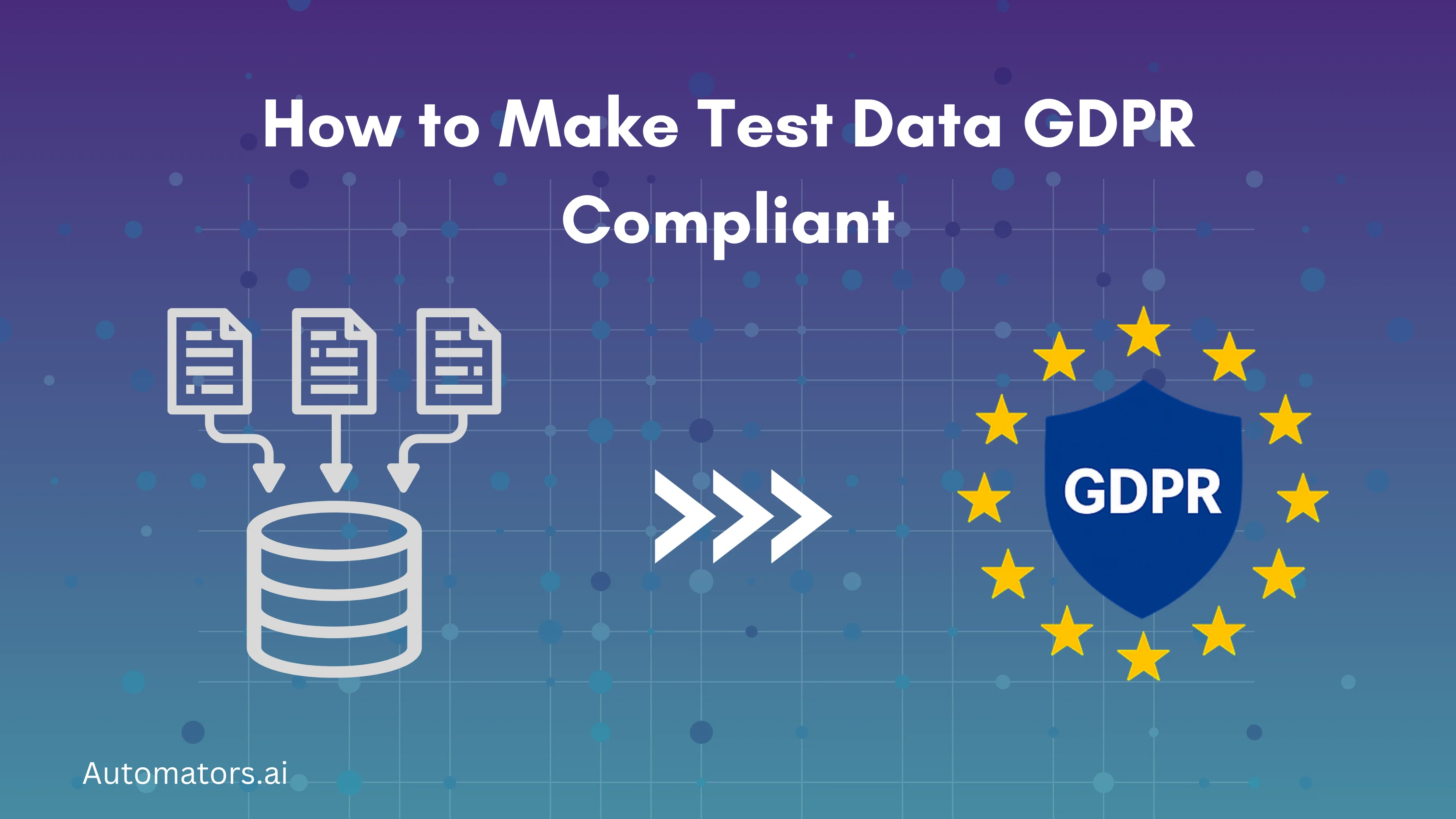
Achieving compliance starts with controlling how test data is generated, transformed, and validated.
The goal is to preserve business logic and referential integrity while eliminating exposure to personal data.
Below are the main techniques organizations use to prepare test data that meets GDPR’s privacy and compliance standards.
| Technique | Description | GDPR Status | Common Limitation |
| Data Masking | Replaces identifiable values with fictitious equivalents. | Pseudonymized | Still reversible if lookup tables or patterns exist. |
| Data Subsetting | Selects smaller, relevant portions of production data. | Pseudonymized | Often exposes relational links or behavioral clues. |
| Data Anonymization | Removes identifiers entirely, irreversibly. | Anonymized (GDPR-exempt) | Can reduce test realism and complexity. |
| Synthetic Data Generation | Creates entirely new data statistically modeled on real data. | Potentially Anonymized | Must be validated for both utility and privacy. |
Let’s look at what each technique means, both conceptually and technically.
a. Data Masking
Data masking replaces real identifiers with fake but correctly formatted values, allowing applications to function as if real data were present.
Technically, it transforms or encrypts original fields while preserving structure, but since the mapping or logic can be reversed, it remains pseudonymized under GDPR.
b. Data Subsetting
Data subsetting selects a smaller, relevant portion of production data for testing to reduce size and complexity.
In other ways, it maintains relational links between tables or entities, but because the subset originates from real records, it still carries potential identifiers and must be handled as personal data.
c. Data Anonymization
Data anonymization removes or generalizes identifiers so that individuals cannot be recognized directly or indirectly.
Under the hood, it applies irreversible transformations, such as aggregation, suppression, or noise injection, so that re-identification is mathematically improbable and the data becomes GDPR-exempt.
d. Synthetic Data Generation
Synthetic data generation creates entirely new, artificial records modeled on the statistical patterns and constraints of real datasets.
Generally, it uses algorithms or generative models to simulate realistic but fictional data points, preserving schema and relationships without referencing any actual individual.
Each of these methods serves a specific purpose, but not every test requires the same kind of data. The next step is choosing which technique best fits your testing and compliance needs.
Choosing the Right Approach for Different Testing Needs
Not every test requires the same kind of data. The most effective compliance strategies combine multiple techniques based on the risk level and purpose of testing.
-
Low-Risk Environments (Front-End and Basic Functionality Testing)
For early-stage or interface-level tests, realistic data isn’t critical. Masked or randomized datasets are usually sufficient, as long as no real identifiers remain.
In these tests, focus on layout, navigation, and data formatting, so privacy risk is low.
-
Moderate-Risk Environments (Integration and Workflow Testing)
When systems start exchanging data across modules, like order management, billing, and user profiles, referential integrity becomes crucial.
Data subsetting or partial anonymization works well here because it keeps real-world relationships intact.
However, since subsets still originate from production data, they must remain under GDPR controls, with encrypted lookup tables and strict access management.
c. High-Risk or Complex Environments (Cross-System or Compliance-Critical Testing)
For environments handling personal or regulated information, even partial pseudonymization isn’t enough. This is where synthetic data becomes the ideal solution.
It mirrors the statistical structure of production data without copying any individual records, enabling accurate, large-scale, and fully compliant testing.
Synthetic data also solves scaling challenges; it can be generated on demand, refreshed per testing cycle, and versioned like any other build artifact.
Unlike pseudonymization, it doesn’t require storing cryptographic keys or lookup tables, removing one of GDPR’s biggest operational risks.
d. Hybrid Strategies for Real-World Teams
Most enterprises adopt a hybrid approach:
- Masking or subsetting for low-risk internal testing.
- Synthetic generation for compliance-critical or shared environments.
This combination balances speed, realism, and privacy without adding governance overhead.
And synthetic test data generation tools like DataMaker automate this hybrid model by generating synthetic datasets directly within QA and DataOps workflows.
It combines statistical modeling, referential-integrity rules, and privacy validation to create GDPR-compliant data at scale, no manual masking, no lookup tables, no re-identification risk.
How to Prove Your Test Data Is GDPR-Compliant
GDPR demands evidence that anonymized data cannot “reasonably” be re-identified.
Traditional risk models assume attackers know everything, forcing organizations to over-sanitize data until it’s useless.
A better approach is Pragmatic Adversarial Modeling, a quantitative framework that measures real-world re-identification risk by simulating plausible attackers:
- Prosecutor Risk: the chance of identifying one known individual.
- Journalist Risk: the chance of identifying anyone in the dataset.
- Marketer Risk: the chance of inferring sensitive attributes without names.
By testing synthetic or anonymized data against these models, teams can assign measurable privacy scores that stand up to audits.
Studies show this pragmatic approach reduces calculated re-identification risk by 90 % to 100 % compared with worst-case assumptions, strong, defensible proof that the dataset meets GDPR’s “negligible-likelihood” threshold.
Making GDPR Compliance Work Across Complex Systems

Large enterprises rarely run a single database; they run microservices, APIs, and distributed data stores.
Each system applies its own masking logic, so identifiers drift out of sync, breaking end-to-end testing and violating referential integrity.
To keep data consistent and compliant, engineers can implement a Decentralized Compliance Token Registry, a blockchain-inspired framework that coordinates pseudonymization secrets securely across systems:
- Encrypted PII is stored off-chain in decentralized storage.
- A smart contract records only the lightweight, immutable cryptographic reference (Content Identifier or CID).
- Access is controlled through Decentralized Attribute-Based Encryption (DABE) policies that allow only authorized services to retrieve tokens, aligning with GDPR Article 32.
This architecture preserves both system independence and regulatory traceability, turning compliance from a bottleneck into an integrated design layer.
Turning GDPR Compliance into a Continuous Process
True compliance isn’t achieved once; it’s maintained continuously. Modern QA and DataOps teams treat privacy like any other quality metric, monitored, automated, and version-controlled.
A GDPR-ready testing pipeline should:
- Provision synthetic data on demand, eliminating production copies.
- Automate privacy validation, including differential-privacy noise and re-identification testing.
- Use ephemeral environments that purge automatically after tests complete.
- Track lineage and metrics for every dataset to prove compliance on request.
This is privacy by design in practice, compliance built into the workflow, not added afterward.
Tools such as DataMaker apply these principles by generating compliant test data automatically within CI/CD pipelines, ensuring every test run meets both technical and legal expectations.
Key Takeaways
- GDPR test data is any dataset that protects individuals from re-identification while maintaining testing validity.
- Masked data isn’t compliant data; pseudonymization still carries legal obligations.
- Synthetic data generation + differential privacy delivers the best balance of realism and safety.
- Pragmatic Adversarial Modeling turns compliance into measurable assurance.
- Decentralized registries solve consistency and auditability across complex systems.
- Embedding these steps in DataOps transforms privacy from policy to continuous practice.
Final Thoughts
Avoiding production data isn’t a limitation; it’s progress.
By designing test environments that are functionally rich but data-absent, organizations eliminate entire classes of risk: privacy breaches, regulatory fines, and operational drag.
The question is no longer “Is our test data safe?”
It’s “Can we prove it?”
When the answer is yes, your QA process becomes not just efficient, but fully GDPR-compliant by design.