SAP TDMS has been part of SAP landscapes for nearly two decades. It was built for a world where teams needed to maintain smaller, realistic, compliant test systems without performing full production copies. In those contexts, TDMS still performs reliably.
But SAP testing today looks very different from the era in which TDMS was designed. SAP teams now run API-led processes, S/4HANA programs, automated regression packs, offshore development cycles, and CI/CD pipelines. These patterns place demands on test data that a copy-based approach like TDMS cannot fully satisfy.
To understand where TDMS fits in 2026, we first need to look at what it actually does, where it still works well, and where it increasingly struggles. Then we will evaluate the alternatives SAP teams typically consider, including synthetic data, and explain why synthetic data has become a strong option for modern SAP QA and automation teams.
What SAP TDMS Actually Does
TDMS extracts a reduced and masked version of production data into non-production systems. Its purpose is clear: help teams operate functional, compliant, production-like test environments without the overhead of full system copies.
The core TDMS extraction models typically include:
- Time-based reduction (copy only recent transactions)
- Company code selection (copy only specific business units)
- Business-object slicing (copy related transactional clusters)
- Master-data–only copies (for training or sandbox systems)
Under the hood, TDMS uses preconfigured SAP packages that understand object dependencies, rebuild document flows, and ensure basic consistency. It also provides rule-based scrambling to remove PII from copied records.
This makes TDMS especially helpful for creating SAP test systems, particularly where realism and compliance are priorities.
Where TDMS Still Works in Modern SAP Landscapes
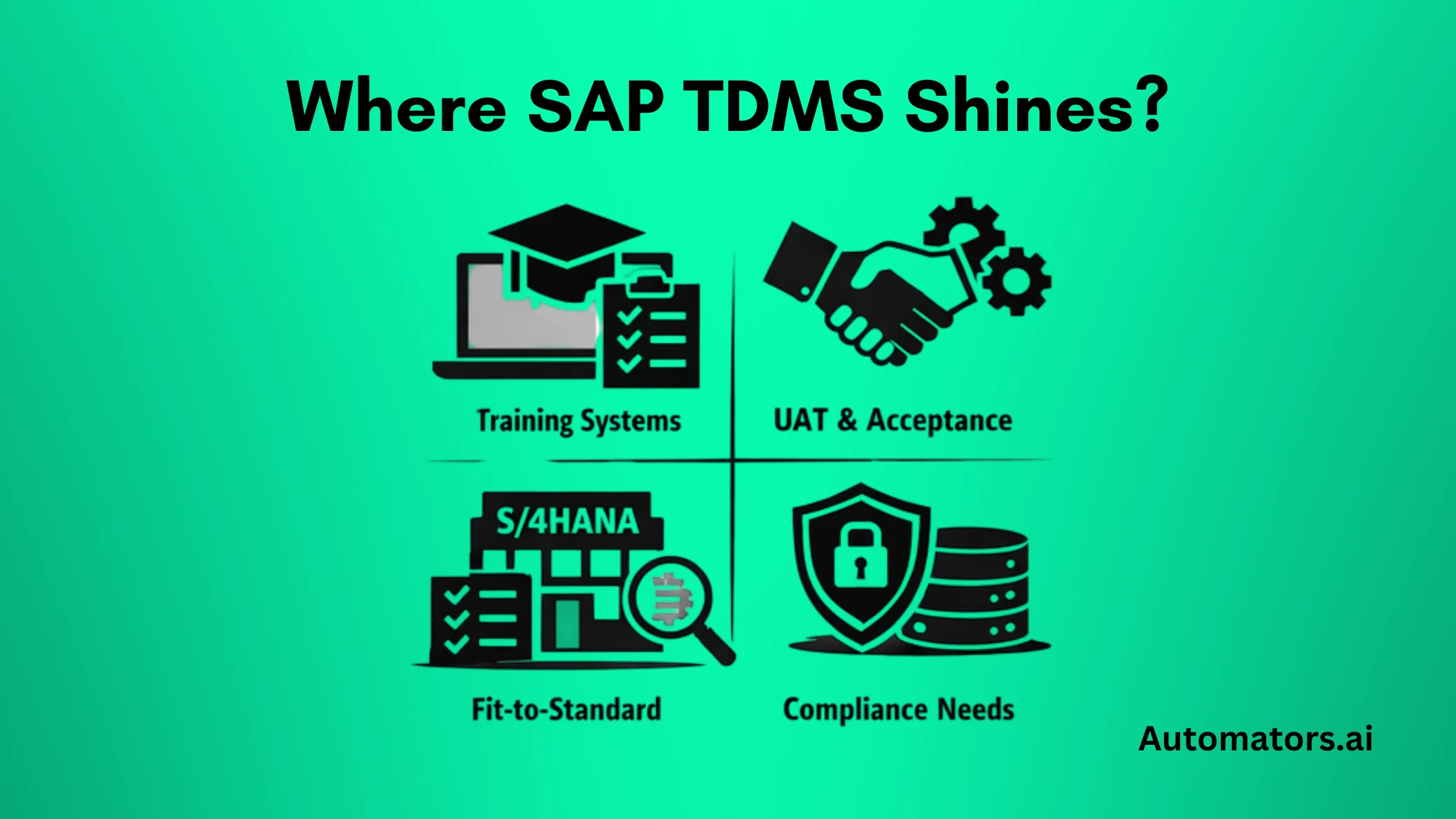
Even as testing needs evolve, TDMS remains very relevant in several scenarios.
-
Training environments Users often want to see familiar document flows, familiar customer histories, and realistic material movements. TDMS provides that because its source is production.
-
UAT and business acceptance cycles When stakeholders validate end-to-end processes, they prefer data that reflects real operations rather than artificially generated scenarios.
-
Fit-to-standard workshops for S/4HANA Teams running demos or reviewing standard processes benefit from real-world examples.
-
Compliance-driven landscapes Companies that cannot expose production data directly often rely on TDMS because it includes masking and ensures a structured, documented refresh process.
In short, TDMS works well when the goal is realism, not repeatability, and when testing does not depend on clean system states or controlled scenario generation.
The Limitations of TDMS for Modern SAP Testing
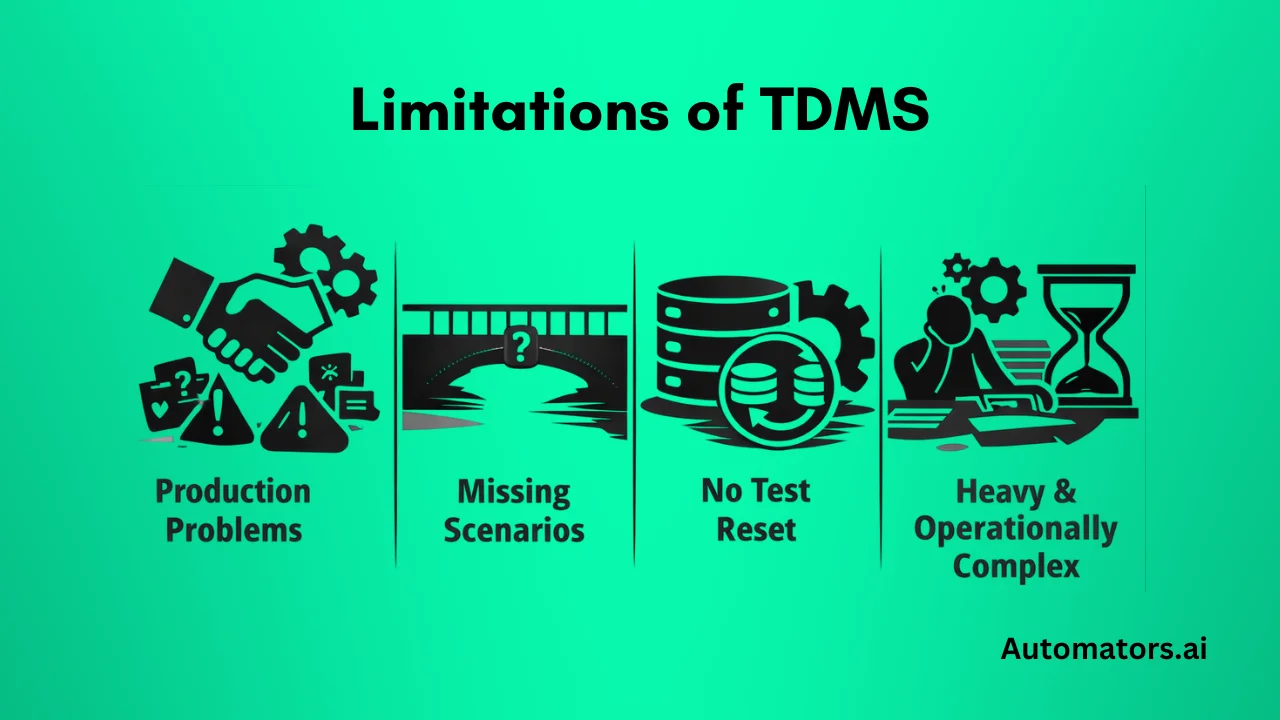
As soon as SAP teams move beyond training and UAT into automation or repeatable validation, TDMS begins to show structural limits. These are not “flaws” in TDMS. They are natural consequences of using production data as the foundation for testing.
A. TDMS copies production conditions exactly as they are
If production contains inconsistent master data, outdated pricing conditions, incorrect partner assignments, poorly maintained materials, or configuration drift, TDMS brings all of it into QA. Masking removes sensitive fields but does not improve data quality or fill scenario gaps.
B. TDMS cannot create missing scenarios
TDMS can only copy what already exists. It cannot generate rare or never-executed scenarios, cross-company flows rarely used in production, deliberate negative cases, or new S/4HANA-specific combinations such as Universal Journal characteristics required for specific validation.
This limits automation coverage and slows down S/4HANA readiness.
C. TDMS cannot reset SAP’s stateful data
SAP systems are stateful. Every test affects stock, balances, document states, credit exposure, and workflow statuses. TDMS has no built-in mechanism to reset these values after tests run.
Teams are forced to:
- refresh entire systems periodically
- manually repair data
- or accept increasing test failures as data becomes unusable
This makes CI/CD pipelines and high-frequency automation difficult to sustain.
D. Running TDMS is slow and operationally heavy
A TDMS refresh usually requires BASIS coordination, business approvals, pre-checks, and validation. In S/4HANA landscapes, where tables like MATDOC and ACDOCA contain massive volumes and more complex object structures, slicing becomes more fragile and error-prone. A single field mismatch can halt a run.
These limitations do not make TDMS a bad tool. They simply reflect that it was never designed to drive high-speed, automation-centered test cycles.
4 TDMS Alternatives SAP Teams Consider
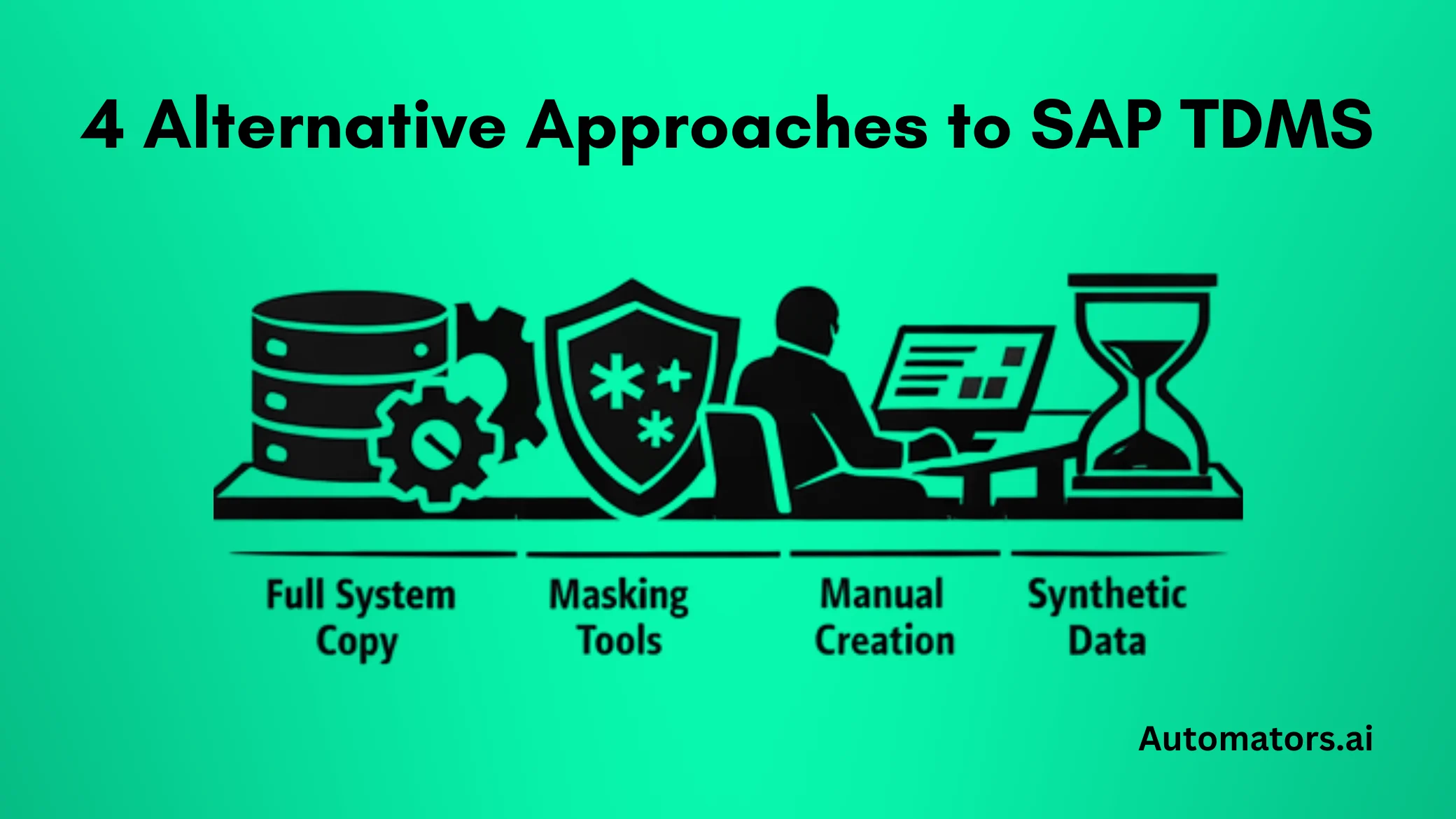
When SAP teams look beyond TDMS, they typically evaluate four alternatives. All of them solve different parts of the test data problem. None of them are universally ideal. The key is understanding how they behave in real SAP environments.
1. Full System Copies
A full system copy is the most straightforward approach because it simply takes the entire production system and duplicates it into a QA or development environment. The process usually runs through SAPinst or an automated copy tool. The result is an exact replica of production with all its historical ledgers, configuration, documents, workflows, and master data intact.
This makes full copies extremely realistic. If your business process exists in production, it will exist in QA exactly the same way. For audits, UAT, or demonstrations, this level of realism is valuable.
However, a full copy behaves just like production, including all of its problems. The system grows larger every time it is copied. Data masking becomes mandatory and adds work. The copied data ages quickly and becomes outdated. And most importantly, nothing can be reset or repeated.
Once automated tests run, they consume the data, shift balances, and modify documents, and there is no way to take the system back to the previous state without performing another full copy. This makes full copies excellent for accuracy but unsuitable for repeatable or high-speed testing.
2. Masking and Subsetting Tools
Masking and subsetting tools take the concept of reusing production data but add more control. Instead of copying everything, they allow teams to extract smaller slices of production and mask sensitive fields before loading them into QA.
This approach works well when compliance is strict or when teams want the familiarity of production data but cannot expose raw information. Subsetting also reduces database size, which helps with cost and system performance. For organizations that refresh QA quarterly or monthly, this is a predictable, structured workflow.
But these tools still inherit production’s limitations. Production quality defines the ceiling. If production has inconsistent master data, incomplete scenarios, or outdated configurations, the QA system will mirror all of it.
Masking protects privacy but does not improve data quality, fix structural issues, or create missing test scenarios. It also does nothing for test repeatability. Once the data is used, it cannot be cleanly reset without performing the entire extraction and masking process again.
3. Manual Test Data Creation
Manual test data creation is the most human-driven approach. A tester or functional consultant simply logs into SAP and creates the data they need for a scenario. For small teams or specific cases, this is convenient. If one sales order or return needs to be validated, creating it manually is often quicker than waiting for a system copy.
However, SAP data is deeply interconnected. Something as simple as a sales order requires correct partner functions, valid pricing conditions, tax determination, stock availability, document types, and accounting integration.
As test suites grow and automation becomes more frequent, the manual method quickly collapses under its own weight. It becomes slow, inconsistent, and nearly impossible to reuse. Manual data creation solves immediate, isolated needs, but it does not support continuous or large-scale testing.
4. Synthetic SAP Test Data Generation
Synthetic data takes a fundamentally different approach. Rather than copying or masking production, it looks at the system’s configuration and generates new, clean, dependency-correct data that fits the rules of that SAP environment.
This means the tool understands your pricing schema, tax logic, material valuation, business partner roles, document types, and FI/CO posting logic. It then uses those rules to build new customers, materials, documents, or processes from scratch.
This approach works extremely well when teams need repeatable testing. If a test case requires a sales order, synthetic data can produce one that is valid, consistent, and resettable.
For CI/CD pipelines, automated regression, API testing, or migration validation, this level of control is difficult to achieve with any copy-based method. Synthetic data can also generate scenarios that do not exist in production, which is helpful for edge cases or S/4HANA migration complexity.
However, synthetic data is not meant to reproduce the natural messiness of how a business actually runs. It does not generate decades of historical patterns, aged stock, user errors, or unpredictable posting combinations.
It is designed for controlled, predictable, and repeatable testing, not for training environments or UAT where business users expect the system to “look and feel” like their real processes.
How to Choose the Right Approach over SAP TDMS
Different testing needs require different data characteristics. The table below summarizes how each approach behaves in real SAP testing environments.
| Capability | Full System Copy | Masking / Subsetting | TDMS | Manual Test Data | Synthetic SAP Data |
| Realism (historical, authentic) | Highest | High | High | Low | Medium (clean realism only) |
| Compliance & PII Protection | Requires masking | Strong | Built-in | Risk of error | Natural (zero PII) |
| Scenario Diversity | Limited to production | Limited | Limited | Moderate | High (can generate missing cases) |
| Repeatability | Low | Low | Low | Low–Medium | High |
| Reset Capability | None | None | None | Manual effort | Built-in (regeneration) |
| CI/CD Readiness | Poor | Poor | Weak | Weak | Strong |
| S/4HANA Migration Fit | Useful for baseline | Partial | Partial | Limited | Strong (scenario-driven) |
| Parallel Execution Stability | Conflicts likely | Conflicts likely | Conflicts likely | Depends on effort | Consistent (fresh sets per run) |
| Operational Overhead | Highest | High | Medium–High | Medium | Low |
| Data Aging / Obsolescence | High | High | High | Medium | Low |
| Data Quality Control | None (inherits prod) | Limited | Inherits prod | Depends on user | High (generated cleanly) |
| Best For | UAT, audits, demos | Compliance-focused orgs | UAT, training, realistic QA | Small functional teams | Automation, CI/CD, migration, high-volume regression |
The Hybrid Model Most SAP Teams Adopt
Most enterprises that modernize their SAP QA processes do not discard TDMS. Instead, they position it where it performs best.
A realistic operating model looks like this:
- Training and UAT systems → TDMS
- Automation, CI/CD, regression environments → synthetic data
- Migration dry-runs → synthetic for controlled edge cases, TDMS for business validation
- Sandbox environments → depends on purpose
This balance gives teams realism where it matters and control where it is required.
Where Tools Like DataMaker Fit
Tools like DataMaker belong to the category of synthetic SAP test data generators. Their role is to create new, dependency-correct customers, vendors, materials, sales documents, and other SAP objects aligned with the system’s configuration.
They are particularly suitable for:
- repeatable automation
- scenario creation
- CI/CD pipelines
- migration testing
- integration and API testing
They do not replace TDMS. They complement it in environments where copy-based methods are not sufficient.
Final Words
SAP TDMS remains an important part of many landscapes, and for good reason. It delivers realism, compliance, and familiar business flows that users expect.
But modern testing requires more than a production snapshot. Automation, CI/CD, and S/4HANA programs need data that is clean, repeatable, and flexible. That is where synthetic data fills the gap.
A balanced strategy that uses TDMS for realism and synthetic data for control gives SAP teams the best of both worlds. The key is choosing the right approach for the job, not relying on a single method to solve every testing problem.